







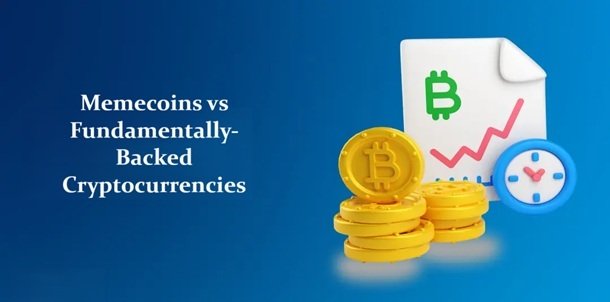
Memecoins and fundamentally backed cryptocurrencies can both generate large price movements, but they are driven by very different factors. Memecoins typically gain attention through internet culture, social-media trends, community participation and speculation. Fundamentally backed cryptocurrencies generally attempt to provide utility through blockchain networks, applications, infrastructure or specific technological functions.
Neither category is risk-free. However, memecoins generally carry higher project-specific and speculative risk because their valuations can depend heavily on sentiment and attention rather than measurable utility or network fundamentals.
For investors, the important question is not simply whether a cryptocurrency is popular. It is whether there is a sustainable reason for people to use, hold and demand the asset over time.
What Are Memecoins?
Memecoins are cryptocurrencies or tokens that are heavily associated with internet memes, jokes, online communities or viral trends.
Examples that have become widely known include Dogecoin and Shiba Inu, although the broader memecoin market contains thousands of smaller tokens.
Memecoins can attract investors because of:
- Viral social-media trends
- Celebrity attention
- Online communities
- Low individual token prices
- Speculative trading
- Strong short-term momentum
A low token price can make a memecoin appear inexpensive, but token price alone says little about whether an asset is fundamentally cheap.
For example, a token priced at ₹0.01 can still have a very large market capitalisation if billions or trillions of tokens are circulating.
What Are Fundamentally Backed Cryptocurrencies?
The term “fundamentally backed cryptocurrency” does not have one universally accepted legal or financial definition. It is generally used to describe cryptocurrencies whose value proposition is connected to an identifiable blockchain network, technology, utility or economic activity.
Examples may include cryptocurrencies associated with:
- Smart-contract platforms
- Decentralised applications
- Blockchain infrastructure
- Decentralised finance
- Data networks
- Payment systems
- Tokenisation infrastructure
Ethereum, for example, is associated with a blockchain platform supporting smart contracts and decentralised applications.
However, having a technological use case does not guarantee that a cryptocurrency will increase in value.
A strong project can still experience major price declines, competition, technical problems or changes in user demand.
Memecoins vs Fundamentally Backed Cryptocurrencies
| Factor | Memecoins | Fundamentally Backed Cryptocurrencies |
| Main driver | Sentiment, trends and community | Utility, adoption and network activity |
| Utility | Often limited or secondary | Usually a central part of the project |
| Volatility | Often extremely high | High, but varies |
| Valuation | Difficult to assess fundamentally | More metrics may be available |
| Long-term predictability | Generally low | Potentially higher, but uncertain |
| Liquidity | Varies widely | Usually stronger for established projects |
| Project risk | Often very high | Depends on network and development |
| Social-media influence | Often very high | Important but usually not the only factor |
| Scam/fraud exposure | High among new tokens | Still present |
| Risk level | Generally very high | Ranges from high to very high |
Why Memecoins Are Often Riskier
The biggest risk with memecoins is dependence on attention.
A memecoin can become popular because of a viral post or influential personality. As more people buy it, the price can rise rapidly.
But the same cycle can work in reverse.
If attention disappears, buyers may leave the market and the price can collapse.
This creates a situation where the price may be driven less by long-term economic activity and more by whether people continue talking about the token.
This is especially dangerous for investors who purchase after a large price increase because they may be buying when speculative enthusiasm is already extremely high.
Utility Does Not Eliminate Risk
It would be incorrect to assume that fundamentally backed cryptocurrencies are automatically safe.
Even a cryptocurrency associated with a successful blockchain can experience:
- Extreme volatility
- Network congestion
- Technical vulnerabilities
- Regulatory changes
- Competition
- Developer or governance problems
- Reduced user adoption
The existence of a real use case can provide a stronger foundation for valuation analysis, but it does not create guaranteed demand.
Investors must distinguish between having utility and being a good investment.
A useful technology can exist without its associated token delivering strong investment returns.
Market Capitalisation Matters More Than Token Price
One of the most common mistakes beginners make is comparing cryptocurrencies based on their individual token price.
Suppose Coin A costs ₹1 and has 100 billion tokens in circulation.
Its approximate market capitalisation would be:
₹1 × 100 billion = ₹100 billion
Another cryptocurrency may cost ₹10,000 per token but have only 1 million tokens.
Its market capitalisation would be:
₹10,000 × 1 million = ₹10 billion
Therefore, the second cryptocurrency is actually much smaller despite having a much higher individual token price.
When evaluating memecoins and other cryptocurrencies, investors should examine market capitalisation, circulating supply, fully diluted valuation and token distribution rather than focusing only on the price of one token.
Liquidity Creates Another Risk
Large, established cryptocurrencies generally have deeper markets than small memecoins.
A small memecoin may appear to have a large percentage gain, but low liquidity can make it difficult for investors to sell large positions.
During a market panic, a lack of buyers can cause prices to fall rapidly.
This creates slippage, meaning the final selling price can be considerably worse than the displayed market price.
Investors should therefore examine trading volume and liquidity before purchasing any cryptocurrency.
Tokenomics Can Affect Risk
Tokenomics refers to how a cryptocurrency’s tokens are created, distributed and used.
Important factors include:
- Total supply
- Circulating supply
- Maximum supply
- Token unlocks
- Allocation to founders
- Allocation to early investors
- Burn mechanisms
- Inflation rate
- Concentration of ownership
Memecoins can sometimes have extremely large supplies or highly concentrated ownership.
If a small number of wallets control a large percentage of the supply, those holders may have considerable influence over the market.
A large token unlock can also increase the amount of cryptocurrency available for sale and potentially create downward pressure.
Rug Pulls and Fraud Risks
New or obscure cryptocurrencies can also carry fraud and rug-pull risks.
A rug pull occurs when project insiders or other participants remove liquidity or sell large holdings, leaving other investors with potentially significant losses.
Memecoin markets can be particularly attractive to opportunistic creators because launching a token can be technically easy and social-media promotion can generate attention quickly.
Investors should be cautious about promises such as:
- Guaranteed returns
- “100×” opportunities
- Risk-free profits
- Secret launches
- Celebrity-endorsed investments
- Urgent buying instructions
Popularity on social media is not proof of legitimacy.
Taxation in India
Indian cryptocurrency investors also need to consider taxation.
The Income Tax Department states that income from the transfer of Virtual Digital Assets (VDAs) is subject to a 30% tax under Section 115BBH, along with applicable surcharge and cess. Relevant transactions are reported through Schedule VDA in the applicable income-tax return.
The tax framework applies to VDAs broadly, so investors should not assume that a memecoin receives completely different treatment simply because it is a meme-based token.
Accurate transaction records are particularly important for active traders who buy and sell multiple tokens.
Which Is More Suitable for Beginners?
For beginners, established cryptocurrencies with identifiable technology and utility are generally easier to research than highly speculative memecoins.
A beginner can examine factors such as:
- Network usage
- Developer activity
- Technology
- Tokenomics
- Liquidity
- Adoption
- Competition
- Security history
A memecoin may provide fewer fundamental metrics and may depend more heavily on social sentiment.
This does not mean beginners should automatically buy fundamentally backed cryptocurrencies. They still carry significant risk.
The main lesson is that investors should understand what they are buying rather than treating every token as equivalent.
How to Evaluate Risk
Before buying any cryptocurrency, investors should ask:
- What problem does the project solve?
- Does the token have a genuine use?
- Who controls the majority of tokens?
- How large is the market capitalisation?
- How liquid is the market?
- Are there upcoming token unlocks?
- How active is development?
- Is the project’s code or security independently reviewed?
- What happens if market sentiment turns negative?
- Can I afford to lose the entire investment?
For memecoins, the final question is especially important.
So, Which Carries More Risk?
Memecoins generally carry more risk than established cryptocurrencies with identifiable utility and stronger fundamentals.
Their prices can be extremely sensitive to social-media trends, speculation and changes in community interest.
Fundamentally backed cryptocurrencies can also lose substantial value, but investors may have more information available to evaluate the underlying network and its adoption.
The distinction is therefore one of degree, not absolute safety.
A cryptocurrency with strong technology can still be a poor investment if its valuation becomes excessive, while a memecoin can remain popular longer than expected.
Conclusion
The memecoins vs fundamentally backed cryptocurrencies comparison highlights one of the most important differences within the crypto market: the source of an asset’s perceived value.
Memecoins often depend heavily on community enthusiasm, internet culture, speculation and social-media attention. This can produce extraordinary short-term gains, but it can also lead to sudden and severe losses.
Fundamentally backed cryptocurrencies generally have a clearer connection to blockchain technology, network activity or specific use cases. This gives investors more factors to analyse, although it does not eliminate volatility, technological risks or investment losses.
For Indian investors, taxation is another consideration. Applicable VDA income currently faces a 30% tax regime under Section 115BBH.
Ultimately, memecoins generally carry greater speculative risk, while established utility-focused cryptocurrencies may offer a stronger basis for fundamental analysis.
However, neither category should be treated as safe. Investors should examine market capitalisation, liquidity, tokenomics, technology, ownership concentration, adoption and security before investing.
The most important rule is simple: never confuse a viral cryptocurrency with a proven investment thesis. A token can become extremely popular without becoming fundamentally valuable, and a technologically strong project can still produce poor investment returns.
Understanding that difference is essential for anyone trying to balance risk and reward in the cryptocurrency market.