







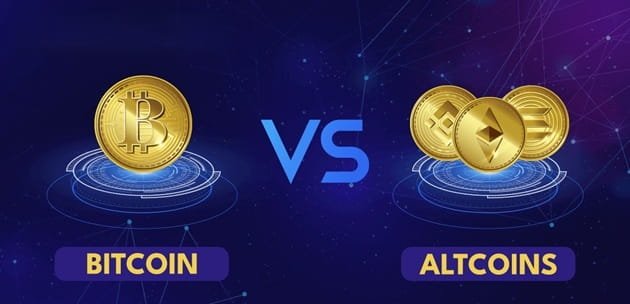
Bitcoin and altcoins are both cryptocurrencies, but they do not carry the same level of risk or potential reward. Bitcoin is the oldest and most established major cryptocurrency, while the term “altcoins” broadly refers to cryptocurrencies other than Bitcoin. This category includes large networks such as Ethereum as well as thousands of smaller tokens with very different technologies, purposes and market structures.
For beginners, treating every cryptocurrency as equally risky can be misleading. Bitcoin generally has greater market maturity and liquidity, while many altcoins can experience much larger price movements in either direction. Understanding these differences is essential before considering cryptocurrency as an investment.
What Is Bitcoin?
Bitcoin was introduced in 2009 and is generally regarded as the first successful decentralised cryptocurrency.
It operates on a blockchain network without relying on a central bank to issue or manage the currency. Transactions are validated through the Bitcoin network, and the protocol has a predetermined maximum supply of 21 million bitcoins.
Bitcoin is often viewed by investors as a digital asset or store-of-value-like investment, although its price remains highly volatile.
Its long operating history, large market size, extensive infrastructure and widespread recognition distinguish it from many newer cryptocurrencies.
However, Bitcoin is not risk-free. Its price can experience major corrections, and investors can lose substantial amounts of money during market downturns.
What Are Altcoins?
“Altcoin” simply means an alternative cryptocurrency to Bitcoin.
The category is extremely broad. It can include:
- Ethereum
- Solana
- Cardano
- Avalanche
- Polygon-related tokens
- Stablecoins
- DeFi tokens
- Gaming tokens
- Meme coins
- Utility tokens
These assets can have completely different objectives.
For example, Ethereum is associated with a blockchain designed to support smart contracts and decentralised applications, while a meme coin may derive much of its market value from community interest and speculation.
Therefore, saying “altcoins are risky” is technically correct in a broad sense but does not explain the differences between individual projects.
Bitcoin vs Altcoins: Key Differences
| Factor | Bitcoin | Altcoins |
| Launch | 2009 | Mostly launched later |
| Market maturity | Highest among cryptocurrencies | Varies considerably |
| Market recognition | Very high | Ranges from high to extremely low |
| Liquidity | Generally strongest | Varies significantly |
| Volatility | High | Often higher |
| Use case | Decentralised digital asset/payment network | Depends on project |
| Competition | Established network | Often competing with many projects |
| Failure risk | Lower relative to most crypto assets | Can be considerably higher |
| Potential upside | High | Potentially much higher for successful projects |
| Downside risk | Significant | Can be extreme |
Why Altcoins Can Offer Higher Returns
One reason altcoins attract investors is their smaller starting market values.
A relatively small cryptocurrency can potentially increase several times in value if adoption, demand and market sentiment grow rapidly.
For example, a token with a small market capitalisation may double more easily than an extremely large asset simply because a smaller amount of additional capital can have a greater proportional effect on its market value.
However, the same characteristic works in reverse.
A small project can lose most of its market value if investors lose confidence, liquidity disappears or the project fails to deliver its promised technology.
Therefore, higher upside potential should always be considered alongside the possibility of much larger losses.
Why Bitcoin Is Generally Considered Less Risky Than Many Altcoins
Bitcoin has several characteristics that can reduce certain types of risk compared with smaller cryptocurrencies.
First, it has the longest operating history among major cryptocurrencies.
Second, it has a large global user and investor base.
Third, Bitcoin generally has deeper liquidity and greater market recognition than most alternative tokens.
Fourth, its monetary policy and maximum supply are widely understood.
These characteristics do not eliminate market risk, but they can make Bitcoin structurally different from a small token launched recently with limited liquidity and an unproven development team.
Altcoins Have Different Use Cases
Another important difference is that altcoins can represent a much wider range of blockchain applications.
Some projects focus on:
- Smart contracts
- Decentralised finance
- Payments
- Gaming
- Artificial intelligence
- Data storage
- Tokenisation
- Blockchain infrastructure
This creates opportunities that Bitcoin’s design does not necessarily target.
However, a promising use case does not automatically mean that the associated token will increase in value.
A blockchain can become useful while the economics of its native token remain weak. Investors therefore need to distinguish between technology adoption and token investment performance.
Liquidity Can Change Risk
Liquidity is especially important when comparing Bitcoin with altcoins.
Bitcoin is traded across many global markets and generally has substantial trading volume.
Smaller altcoins can have much thinner order books.
This means that an investor may have difficulty selling a large position without significantly affecting the market price.
Low liquidity can make losses worse during periods of panic because many investors may attempt to exit simultaneously.
Beginners should therefore avoid judging an altcoin solely by its percentage return. The ability to enter and exit a position at a reasonable price also matters.
Volatility Is Usually Higher in Altcoins
Cryptocurrency markets are volatile in general, but altcoins can be considerably more volatile than Bitcoin.
A major altcoin may rise 30%, 50% or more during a strong market period, but it can also experience equally dramatic declines.
Smaller tokens may move even more sharply because of limited liquidity, concentrated ownership, social-media activity and speculative trading.
Bitcoin can also experience substantial price swings, but its larger market size generally makes extreme short-term movements less common than in very small tokens.
The Role of Market Sentiment
Both Bitcoin and altcoins are heavily influenced by market sentiment.
During bullish periods, investors may initially move toward Bitcoin because it is the most established cryptocurrency. As confidence grows, capital can move into higher-risk altcoins in search of larger returns.
This is sometimes described as a rotation from Bitcoin into alternative cryptocurrencies.
The opposite can happen during market stress. Investors may reduce exposure to smaller tokens first, increasing their preference for more established assets.
This can cause altcoins to fall much faster than Bitcoin during certain downturns.
Regulatory and Legal Risks
Cryptocurrency investors also need to consider regulatory risk.
In India, Virtual Digital Assets have a specific tax framework. The Income Tax Department states that income from the transfer of VDAs is subject to a 30% tax under Section 115BBH, along with applicable surcharge and cess.
The tax treatment applies to VDAs broadly and does not mean that every cryptocurrency has the same legal characteristics.
Investors should also be careful with overseas platforms, unregulated offerings and tokens making unrealistic profit claims.
The Reserve Bank of India has repeatedly highlighted risks associated with private cryptocurrencies, including financial, legal, customer-protection, operational and security risks.
Bitcoin vs Altcoins: Pros and Cons
Bitcoin Advantages
- Longest track record among major cryptocurrencies
- Strong global recognition
- Generally higher liquidity
- Large and established ecosystem
- Clearly defined maximum supply
- Lower project-specific risk than many smaller tokens
Bitcoin Disadvantages
- Still highly volatile
- Can experience major price declines
- Does not provide guaranteed income
- Regulatory and tax considerations remain important
- Requires secure custody
Altcoin Advantages
- Potentially higher growth opportunities
- Exposure to different blockchain technologies
- Wide range of use cases
- Opportunities in emerging sectors
- Some projects can grow significantly if adoption increases
Altcoin Disadvantages
- Often much higher volatility
- Greater liquidity risk
- Higher project-failure risk
- Some tokens have weak or unclear use cases
- Greater exposure to speculation and market manipulation
- Some projects may become inactive or lose community support
Why Market Capitalisation Matters
Beginners often look only at the price of a cryptocurrency.
That can be misleading.
A token priced at ₹10 is not necessarily cheaper than Bitcoin priced at several lakh rupees. What matters more is market capitalisation, which broadly represents the total market value of all tokens in circulation.
A cryptocurrency with a huge supply can have a low individual token price while still having a very large total market value.
Investors should therefore examine circulating supply, maximum supply, market capitalisation, token distribution and liquidity before comparing cryptocurrencies.
Which Is Better for Beginners?
For someone new to cryptocurrency, Bitcoin is generally easier to understand than a small altcoin because its history, monetary design and market structure are relatively well documented.
That does not make Bitcoin safe.
A beginner should understand that losing 30% or more during a market correction is possible even with Bitcoin.
Altcoins require additional research because investors need to evaluate the technology, development team, tokenomics, competition, liquidity, use case and community.
A token’s popularity on social media should not be treated as evidence of long-term value.
Should Investors Buy Both?
Some investors choose to hold Bitcoin and a selection of altcoins rather than concentrating entirely on one cryptocurrency.
This can provide exposure to different parts of the crypto ecosystem, but diversification within cryptocurrency does not eliminate market risk.
Many altcoins can fall simultaneously during a major market downturn.
Therefore, investors should consider cryptocurrency as one part of their overall financial plan rather than assuming that holding several tokens automatically creates a balanced portfolio.
Conclusion
The difference between Bitcoin and altcoins is not simply that one is older and the others are newer. The two categories have substantially different risk and reward characteristics.
Bitcoin’s long history, large market size, liquidity, recognition and established network make it structurally different from many smaller cryptocurrencies. It can still experience significant losses, but project-specific risks are generally lower than those associated with an unproven token.
Altcoins offer potentially much greater upside because some emerging projects can grow rapidly. However, they also carry higher volatility, liquidity risk, technological risk, competition and the possibility of complete or near-complete loss.
For Indian investors, applicable VDA taxation is another important consideration, with income from VDA transfers currently subject to a 30% tax regime under Section 115BBH.
Ultimately, Bitcoin may offer a relatively lower-risk way to gain cryptocurrency exposure, while altcoins can offer greater potential rewards at the cost of substantially greater risk.
The most important lesson for beginners is not to chase the cryptocurrency that has risen the most. Instead, evaluate its market size, liquidity, technology, use case, tokenomics, security, regulatory environment and potential downside before investing.
In cryptocurrency, higher potential reward almost always comes with higher uncertainty. Understanding that relationship is essential before deciding how much risk to take.