










Higher education can involve significant expenses, including tuition fees, accommodation, books, travel and other academic costs. For many students and families, an education loan can help spread these expenses over a longer period. Before borrowing, however, it is important to understand what repayment could look like after the loan enters its repayment phase.
A student loan calculator helps estimate the monthly payment by using information such as the loan amount, interest rate and repayment period. In India, education-loan repayment can also involve a moratorium period, during which repayment conditions may differ from a standard personal loan. Therefore, understanding how the calculator works can help students and co-borrowers prepare a more realistic financial plan.
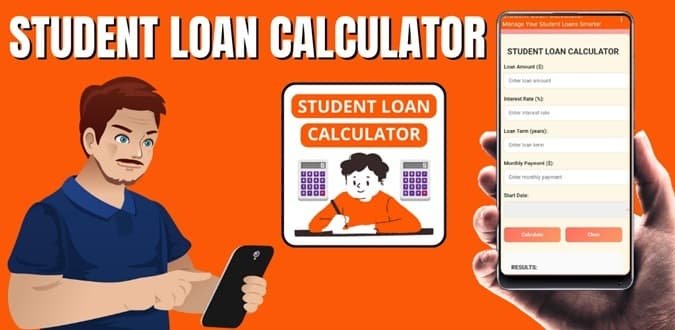
What Is a Student Loan Calculator?
A student loan calculator is an online financial tool that estimates the repayment amount for an education or student loan.
The basic calculator generally requires three inputs:
- Loan amount: The amount borrowed.
- Interest rate: The annual interest charged by the lender.
- Repayment tenure: The period over which the loan is repaid.
More advanced calculators may also ask about the study period, moratorium, course duration, accumulated interest and repayment start date.
The calculator processes these inputs and produces an estimated EMI or monthly repayment amount.
The Three Main Inputs
1. Loan Amount
The loan principal is the amount financed by the lender.
For example, suppose the total eligible education expenses are ₹12 lakh and the student or family contributes ₹2 lakh. If the remaining ₹10 lakh is financed, the calculator can use ₹10 lakh as the principal.
A higher principal generally means a higher monthly repayment when the interest rate and tenure remain unchanged.
The actual amount sanctioned depends on the lender’s assessment, eligible expenses, applicant profile and applicable loan conditions.
2. Interest Rate
The interest rate determines the cost of borrowing.
Education loans may have different interest-rate structures depending on the lender, borrower profile, course, institution and applicable scheme.
For a standard monthly EMI calculation, an annual interest rate is generally converted into a monthly rate.
For example, if the annual rate is 10%:
Monthly interest rate = 10% ÷ 12 = 0.8333%
A change in the interest rate can significantly affect both the monthly payment and total interest.
3. Repayment Tenure
Tenure is the period available to repay the loan after repayment begins.
A longer tenure generally reduces the monthly EMI because the outstanding amount is distributed across more instalments. However, it can increase the total interest paid over the repayment period.
A shorter tenure generally has a higher EMI but can reduce the overall interest cost.
How the EMI Formula Works
For a standard reducing-balance loan, a calculator commonly uses the following formula:
EMI = P × R × (1 + R)ⁿ ÷ [(1 + R)ⁿ − 1]
Where:
- P = Principal loan amount
- R = Monthly interest rate
- n = Number of monthly instalments
The formula produces a periodic payment that combines principal and interest.
The actual repayment structure of an education loan can differ depending on the lender and agreement, so borrowers should check the sanctioned repayment schedule.
Example of Student Loan EMI Calculation
Suppose a student borrows ₹10 lakh at an assumed interest rate of 10% per year and begins repayment over a 10-year period.
The calculation uses:
- Principal = ₹10,00,000
- Annual interest rate = 10%
- Monthly interest rate = approximately 0.8333%
- Tenure = 120 months
Using the standard EMI formula, the estimated monthly payment is approximately ₹13,215.
The estimated total repayment would be:
₹13,215 × 120 = approximately ₹15.86 lakh
The approximate interest component would therefore be:
₹15.86 lakh − ₹10 lakh = ₹5.86 lakh
These figures are illustrative and assume a standard reducing-balance calculation. The actual education-loan repayment can differ based on the lender’s interest rate, moratorium treatment, repayment terms and other applicable conditions.
Understanding the Moratorium Period
One of the important differences between education loans and many other consumer loans is the possibility of a moratorium period.
Depending on the loan terms, repayment may begin after completion of the course and an additional specified period. Interest treatment during this period can affect the eventual amount that must be repaid.
For example, if interest continues to accrue during the study or moratorium period, the outstanding amount at the beginning of regular repayment may be higher than the original principal.
A basic EMI calculator that only considers the original loan amount may therefore underestimate the eventual repayment if it does not account for accrued interest.
Students should check whether their calculator includes the study period, moratorium and interest accrued before repayment begins.
How Tenure Changes Monthly Payments
Consider the same ₹10 lakh loan at an assumed 10% annual interest rate.
An illustrative comparison is:
| Repayment Tenure | Approx. Monthly EMI | Approx. Total Interest |
| 5 years | ₹21,247 | ₹2.75 lakh |
| 7 years | ₹16,602 | ₹3.94 lakh |
| 10 years | ₹13,215 | ₹5.86 lakh |
The longer 10-year period reduces the monthly payment compared with the five-year option. However, the total interest is considerably higher.
This shows why students and co-borrowers should evaluate both monthly affordability and total repayment cost.
Principal and Interest Components
The monthly payment generally contains two parts: principal and interest.
At the beginning of repayment, the outstanding principal is relatively high, so the interest component can represent a larger portion of the payment.
As instalments are paid and the principal decreases, the interest calculated on the outstanding balance generally decreases, assuming the applicable rate remains unchanged.
The amortisation schedule therefore helps borrowers understand how their loan balance changes over time.
What About Floating Interest Rates?
Some education loans may have floating interest rates. If the applicable rate changes, future repayment conditions can change as well.
Depending on the lender’s terms, a rate change may result in a change in the EMI, loan tenure or both.
Therefore, an EMI calculator using the current interest rate provides an estimate rather than a guarantee that the same EMI will continue throughout the entire loan period.
Borrowers should review the interest-rate terms in the loan agreement.
Can a Calculator Include Education Loan Tax Benefits?
A calculator may show repayment figures, but tax benefits are a separate consideration.
In India, eligible borrowers may be able to claim a deduction for qualifying interest paid on an education loan under Section 80E of the Income-tax Act, subject to the applicable conditions.
The tax treatment should not be confused with the EMI calculation. A borrower should separately determine eligibility and applicable tax rules for the relevant assessment year.
What Student Loan Calculators Do Not Show
An online calculator cannot determine whether a student qualifies for an education loan or how much a lender will ultimately sanction.
It may not account for:
- Processing fees
- Insurance or other charges
- Interest accrued during a moratorium
- Changes in floating interest rates
- Course-related disbursements
- Prepayments
- Lender-specific repayment rules
The final loan agreement and repayment schedule remain the authoritative sources for the actual obligation.
How to Use a Student Loan Calculator Effectively
Students and families can get more useful estimates by entering realistic figures.
First, determine the expected education expenses and the amount that actually needs financing. Then use the lender’s applicable interest rate and compare multiple repayment tenures.
If there is a moratorium, check whether the calculator allows the study period and accrued interest to be included. Finally, compare the estimated EMI with expected post-study income and other financial obligations.
Testing several scenarios can reveal how changes in loan amount, interest rate and tenure affect repayment.
Conclusion
Student loan calculators estimate monthly payments primarily by using the loan amount, interest rate and repayment tenure. For a standard amortising loan, the calculator applies an EMI formula to determine the estimated periodic payment and total interest.
Education loans require additional attention because the study period and moratorium can affect when repayment begins and how interest accumulates. Floating rates, fees and lender-specific conditions can also change the actual repayment amount.
A calculator is therefore best used as a financial planning tool, not as a final loan quote. Comparing EMI, total interest, repayment tenure and the effect of any moratorium can help students and families understand the potential cost of education financing before accepting a loan.