










When looking for low-risk investment options in India, Debt Mutual Funds and Bank Recurring Deposits (RDs) are two popular choices. Both are designed for investors who want relatively stable returns while preserving their capital. However, they differ in terms of returns, flexibility, taxation, liquidity, and investment strategy.
A Debt Mutual Fund invests primarily in fixed-income securities such as government bonds, corporate bonds, treasury bills, and money market instruments. Its returns are market-linked and depend on interest rates and the performance of the underlying securities.
A Bank Recurring Deposit (RD) is a savings product offered by banks that allows investors to deposit a fixed amount every month for a predetermined period while earning a fixed rate of interest.
If you are unsure whether to choose a Debt Mutual Fund or a Bank RD, this detailed comparison will help you understand the advantages, disadvantages, and suitability of each investment option.
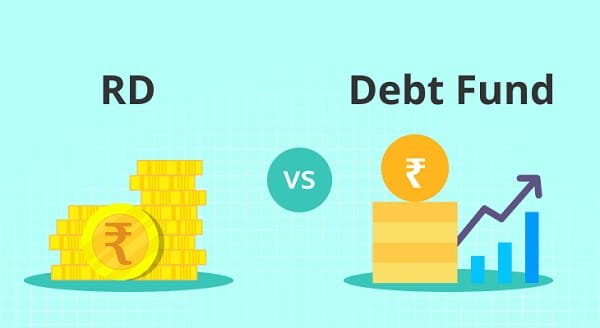
What is a Debt Mutual Fund?
A Debt Mutual Fund is a type of mutual fund that primarily invests in fixed-income securities. The objective is to generate relatively stable returns while managing investment risk.
Debt Mutual Funds may invest in:
- Government Securities (G-Secs)
- Treasury Bills (T-Bills)
- Corporate Bonds
- Commercial Papers (CPs)
- Certificates of Deposit (CDs)
- Money Market Instruments
Unlike bank deposits, Debt Mutual Fund returns are not guaranteed because the value of the securities in the portfolio can change with interest rates and market conditions.
What is a Bank Recurring Deposit (RD)?
A Recurring Deposit (RD) is a fixed-income savings scheme offered by banks and some financial institutions. Investors deposit a fixed amount every month for a chosen tenure, typically ranging from six months to ten years.
The bank pays a fixed interest rate throughout the tenure, and the investor receives the accumulated amount along with interest at maturity.
RDs are ideal for individuals who want to develop a disciplined savings habit while earning predictable returns.
Debt Mutual Fund vs Bank RD: Key Differences
| Feature | Debt Mutual Fund | Bank Recurring Deposit |
| Investment Type | Mutual Fund | Bank Deposit |
| Risk Level | Low to Moderate | Very Low |
| Returns | Market-linked | Fixed and guaranteed |
| Return Potential | Moderate | Moderate |
| Capital Protection | Not guaranteed | Generally high, subject to applicable banking regulations |
| Liquidity | High (depends on fund type) | Premature closure usually allowed with conditions |
| Monthly Investment | Optional | Mandatory monthly deposit |
| Professional Management | Yes | No |
| Suitable Investment Horizon | Short to Medium Term | Short to Medium Term |
Advantages of Debt Mutual Funds
1. Better Flexibility
Debt Mutual Funds allow investors to invest through lump sums or systematic investment plans (SIPs). There is generally no requirement to invest a fixed amount every month.
2. Professional Fund Management
Experienced fund managers actively manage the portfolio by selecting debt securities based on interest rate expectations, credit quality, and market conditions.
3. Higher Liquidity
Many Debt Mutual Funds allow investors to redeem their investments on any business day, although some schemes may have exit loads or other conditions.
4. Portfolio Diversification
Debt Mutual Funds invest across multiple debt instruments, helping diversify credit and interest rate exposure.
5. Variety of Investment Options
Investors can choose from different categories such as:
- Liquid Funds
- Ultra Short Duration Funds
- Short Duration Funds
- Corporate Bond Funds
- Gilt Funds
- Money Market Funds
Disadvantages of Debt Mutual Funds
- Returns are not guaranteed.
- Interest rate movements can affect returns.
- Certain funds may carry credit risk depending on the quality of securities held.
- Performance may vary across different market conditions.
Advantages of Bank Recurring Deposits
1. Guaranteed Returns
One of the biggest advantages of a Bank RD is that the interest rate is fixed at the time of opening the account, making returns predictable.
2. Disciplined Saving Habit
Since investors deposit a fixed amount every month, RDs encourage regular savings and financial discipline.
3. Low Investment Risk
Bank RDs are considered among the safest savings options because they are not directly affected by market fluctuations.
4. Easy to Understand
Recurring Deposits are simple financial products that require very little investment knowledge.
5. Flexible Tenure
Banks offer multiple tenure options, allowing investors to choose a period that matches their financial goals.
Disadvantages of Bank Recurring Deposits
- Returns are generally lower than the long-term potential of many market-linked investments.
- Monthly deposits are compulsory throughout the chosen tenure.
- Premature withdrawal may reduce the effective return due to penalties or revised interest rates.
- Returns may not keep pace with inflation over long periods.
Return Comparison
Debt Mutual Funds and Bank RDs offer different return profiles.
Debt Mutual Funds aim to generate returns from interest income and changes in bond prices. Their performance depends on interest rate movements, credit quality, and the fund manager’s investment decisions. As a result, returns may be higher or lower than expected and are not guaranteed.
Bank RDs provide fixed returns that remain unchanged throughout the deposit tenure. Investors know exactly how much they will receive at maturity, making RDs suitable for those who value certainty.
If your priority is predictable income, a Bank RD may be preferable. If you are comfortable with some market-related fluctuations in pursuit of potentially better returns, a Debt Mutual Fund may be worth considering.
Risk Comparison
Debt Mutual Funds
- Interest rate risk.
- Credit risk (depending on portfolio quality).
- Market-linked returns.
- Low to moderate volatility.
Bank Recurring Deposits
- Very low investment risk.
- Fixed interest rate.
- Predictable maturity amount.
- Minimal exposure to market fluctuations.
Liquidity Comparison
Most open-ended Debt Mutual Funds allow investors to redeem units on business days, making them relatively liquid.
Bank RDs generally allow premature closure, but this may involve penalties or lower applicable interest rates depending on the bank’s terms and conditions.
For investors who require greater flexibility, Debt Mutual Funds may offer an advantage.
Taxation
1. Debt Mutual Funds
The taxation of Debt Mutual Funds depends on the prevailing income tax laws, the type of fund, and the holding period. Investors should check the latest tax rules before investing.
2. Bank Recurring Deposits
Interest earned on a Bank RD is generally taxable according to the investor’s applicable income tax slab. Banks may deduct Tax Deducted at Source (TDS) where required under current tax regulations.
Since tax rules may change, it is advisable to consult the latest guidelines or a qualified tax professional.
Who Should Choose a Debt Mutual Fund?
Debt Mutual Funds are suitable for investors who:
- Want relatively stable market-linked returns.
- Need higher liquidity.
- Prefer professionally managed investments.
- Have short- to medium-term financial goals.
- Can tolerate limited market fluctuations.
Who Should Choose a Bank RD?
Bank RDs are ideal for individuals who:
- Prefer guaranteed returns.
- Want disciplined monthly savings.
- Have a low risk tolerance.
- Need certainty regarding maturity value.
- Are saving for short-term goals such as education, travel, or a planned purchase.
Can You Invest in Both?
Yes. Many investors use both Debt Mutual Funds and Bank RDs as part of a diversified financial plan.
For example:
- Use a Bank RD for disciplined monthly savings toward a fixed goal where predictable returns are important.
- Invest in a Debt Mutual Fund for surplus money that may benefit from greater flexibility and the potential for market-linked returns.
Combining both options can help balance stability, liquidity, and return potential.
Debt Mutual Fund vs Bank RD: Which is Better?
There is no single investment option that is suitable for everyone.
Choose a Debt Mutual Fund if you want professional management, higher flexibility, better liquidity, and are comfortable with low to moderate market risk.
Choose a Bank Recurring Deposit if your priority is guaranteed returns, disciplined monthly savings, and capital preservation with minimal risk.
The right choice depends on your financial goals, investment horizon, liquidity requirements, and willingness to accept market fluctuations.