







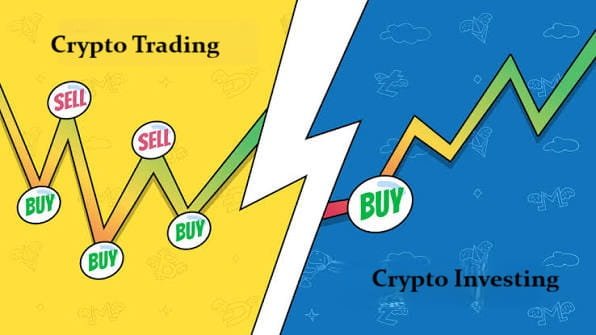
Crypto trading and crypto investing both involve buying and selling digital assets, but they differ significantly in their time horizon, objectives, strategies and risk management. Crypto traders generally try to profit from shorter-term price movements, while crypto investors usually buy assets with the expectation that their value will increase over a longer period.
The difference is important because the same cryptocurrency can be approached in completely different ways. A trader may buy Bitcoin because they expect its price to rise over the next few hours or days. A long-term investor may buy Bitcoin because they believe adoption of digital assets will increase over several years.
Neither approach guarantees profits. Cryptocurrency markets can be highly volatile, and both trading and investing can result in substantial losses.
What Is Crypto Trading?
Crypto trading focuses primarily on short-term or medium-term price movements.
Traders may hold an asset for seconds, hours, days or weeks, depending on their strategy. Their objective is usually to take advantage of changes in market price rather than simply hold the cryptocurrency for many years.
Common crypto trading strategies include:
- Day trading
- Swing trading
- Scalping
- Momentum trading
- Breakout trading
- Trend following
Traders often use charts, technical indicators, trading volume, market sentiment and price patterns to make decisions.
Some traders also use derivatives such as futures, which can introduce leverage and significantly increase both potential gains and losses.
What Is Crypto Investing?
Crypto investing generally involves buying digital assets with a longer-term perspective.
An investor may hold Bitcoin, Ether or another cryptocurrency for months or years based on the belief that its underlying network, adoption or utility will grow.
Instead of focusing primarily on daily price movements, investors may study:
- Blockchain technology
- Token economics
- Network adoption
- Developer activity
- Market position
- Supply and demand
- Competition
- Long-term use cases
- Regulatory developments
The objective is generally to benefit from long-term appreciation rather than repeatedly buying and selling short-term price movements.
Crypto Trading Vs Crypto Investing: Key Differences
| Factor | Crypto Trading | Crypto Investing |
| Time horizon | Short to medium term | Medium to long term |
| Main objective | Profit from price movements | Benefit from long-term growth |
| Research | Technical + market analysis | Fundamental + market analysis |
| Frequency of transactions | Usually high | Usually lower |
| Costs | Potentially higher | Generally lower |
| Emotional pressure | Often high | Usually lower |
| Leverage | Sometimes used | Generally avoided |
| Main risk | Frequent losses and volatility | Long-term asset failure or major decline |
| Time required | Often significant | Usually less |
| Suitable approach | Active participants | Long-term investors |
Difference in Time Horizon
Time horizon is perhaps the simplest way to understand the difference.
A trader might purchase Ethereum today because a technical indicator suggests a possible price breakout and sell it tomorrow.
An investor might purchase Ethereum because they believe Ethereum’s blockchain ecosystem will remain important over the next five or ten years.
The trader is primarily concerned with when the price will move.
The investor is more concerned with whether the asset will become more valuable over time.
Different Types of Research
Crypto traders and investors also approach research differently.
Traders
Traders may examine:
- Price charts
- Moving averages
- Support and resistance
- Trading volume
- Market momentum
- Volatility
- Technical indicators
- Market news
The focus is on identifying possible entry and exit points.
Investors
Long-term investors may examine:
- Token supply
- Network adoption
- Blockchain activity
- Development teams
- Competitive advantages
- Use cases
- Governance
- Security
- Regulatory developments
An investor may tolerate temporary price declines if the long-term investment thesis remains intact.
Risk Is Different, Not Absent
It would be incorrect to say that trading is always riskier than investing or that investing is automatically safe.
The risks are simply different.
A trader makes frequent decisions. Even a small mistake repeated many times can accumulate into substantial losses. Trading fees, spreads and poor execution can also reduce returns.
Leverage can make trading particularly dangerous. A relatively small adverse price movement can cause a leveraged position to lose a large portion of its capital or be liquidated.
Long-term investors avoid many short-term trading costs, but they face another major risk: the possibility that the cryptocurrency they hold fails to deliver its expected long-term value.
A token can lose relevance, face competition, experience security problems or decline dramatically in adoption.
Trading Requires More Time
Active crypto trading can be demanding.
Markets operate continuously, including weekends and holidays. Prices can change rapidly, and traders may need to monitor charts, news and open positions regularly.
This can create significant psychological pressure.
Investors generally have more flexibility because they do not need to react to every short-term price movement.
Someone investing for five years does not necessarily need to worry about whether Bitcoin falls 5% on a particular afternoon.
Transaction Costs Matter
Frequent trading can create more costs.
These may include:
- Trading fees
- Bid-ask spreads
- Withdrawal fees
- Network fees
- Funding costs on derivatives
- Slippage
A strategy that appears profitable before costs may become much less attractive after accounting for them.
Long-term investors generally make fewer transactions, potentially reducing these costs.
However, investors can still face fees when purchasing, selling or transferring cryptocurrency.
Tax Considerations in India
Tax is particularly important for Indian crypto participants because the tax framework for virtual digital assets differs from traditional investments.
The Income Tax Department states that income from the transfer of Virtual Digital Assets (VDAs) is taxed at 30% under Section 115BBH, along with applicable surcharge and 4% cess. Relevant VDA transactions are reported through Schedule VDA in the income-tax return.
This means frequent transactions can create additional record-keeping requirements.
Traders should maintain detailed records of purchases, sales, dates, quantities and transaction values.
Investors also need accurate records because selling or transferring digital assets can have tax implications.
Professional tax advice may be appropriate where transactions are frequent or complex.
The Role of Emotional Discipline
Psychology plays an important role in both approaches.
Crypto prices can rise or fall rapidly, creating fear and greed.
Traders may be tempted to:
- Chase rising prices
- Overtrade
- Increase leverage after losses
- Exit profitable trades too early
- Hold losing trades too long
Investors may also panic during major market crashes or buy assets simply because prices are rising.
A clearly defined strategy can help reduce emotional decisions.
Which Approach Is Better for Beginners?
For many beginners, long-term investing may be easier to manage than active trading.
Trading requires knowledge of market mechanics, technical analysis, risk management and execution. It also requires greater time commitment.
Long-term investing still requires research, but investors generally do not need to make as many decisions.
However, investing does not mean buying any cryptocurrency and holding it indefinitely. Investors should still evaluate the asset and periodically reassess whether their original thesis remains valid.
Can You Combine Trading and Investing?
Yes.
Some participants maintain separate portfolios.
For example:
Long-term portfolio: Bitcoin or other assets selected for a multi-year investment thesis.
Trading portfolio: A smaller amount used for active strategies.
Keeping these objectives separate can make it easier to track performance and prevent short-term trades from interfering with long-term holdings.
However, both portfolios remain exposed to cryptocurrency-market risks.
Crypto Trading Vs Crypto Investing: Which Is More Suitable?
Crypto trading may suit someone who:
- Has sufficient time to monitor markets
- Understands technical analysis
- Can manage risk strictly
- Accepts frequent gains and losses
- Understands leverage and derivatives
- Can control emotional decision-making
Crypto investing may suit someone who:
- Has a longer investment horizon
- Prefers lower transaction frequency
- Believes in long-term blockchain adoption
- Does not want to monitor prices constantly
- Can tolerate significant volatility
- Is willing to research cryptocurrency fundamentals
Neither approach is guaranteed to outperform the other.
Conclusion
The main difference between crypto trading vs crypto investing is the objective and time horizon.
Crypto trading attempts to profit from relatively short-term price movements. It often involves frequent transactions, technical analysis and potentially greater time and emotional commitment. Leverage can further increase risk.
Crypto investing focuses on the longer-term potential of digital assets. Investors generally pay more attention to technology, adoption, token economics, competition and the future role of a cryptocurrency.
For many beginners, long-term investing can be easier to manage because it involves fewer trading decisions and does not require constant market monitoring. However, investors still face substantial risks, including major price declines and the possibility that a cryptocurrency fails to achieve its expected adoption.
Indian participants must also account for the special tax treatment of VDAs, where transfers are subject to a 30% tax under Section 115BBH, plus applicable surcharge and cess.
Ultimately, the better approach depends on an individual’s time horizon, knowledge, risk tolerance, capital and ability to manage emotions. Trading is an active activity that requires continuous decision-making, while investing is primarily a long-term commitment to an asset’s potential.
Understanding this distinction before putting money into cryptocurrency can help investors choose a strategy that matches their actual financial goals rather than simply following short-term market excitement.