








A property investor who wants regular rental income usually faces one basic choice: buy a flat or house and rent it to a family, or put more money into an office, shop or other commercial unit and lease it to a business. Residential property is familiar, easier to understand and often easier to finance. Commercial property can produce much higher rent, but vacancies can be longer and the investment is more sensitive to tenant quality and business location.
In India, the right choice is not simply the property with the highest advertised rent. Investors should compare purchase price, realistic rent, vacancy risk, maintenance, lease length, resale demand and how much time they can give to managing the property.
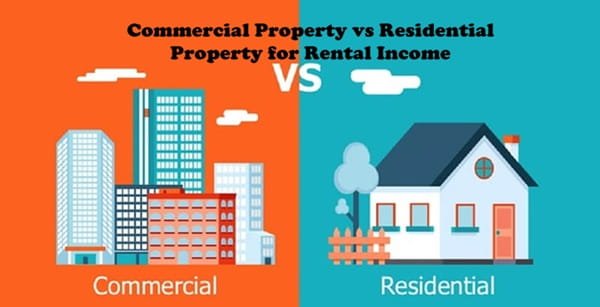
How Residential Rental Property Works
Residential rental property includes apartments, independent houses, builder floors and villas leased to individuals or families. Demand is driven mainly by jobs, schools, transport, neighbourhood quality and affordability.
A well-located 1 BHK or 2 BHK near an IT park, hospital, university or business district can attract a broad tenant pool. That makes residential property relatively easy to understand for a first-time landlord. Tenants may change every year or two, but another family or working professional can often replace them if the locality has healthy demand.
Rental Income from Residential Property
Residential property generally offers lower rental yields than commercial real estate. Across Indian cities, gross residential yields often fall around 2% to 4%, although some high-demand markets and smaller, efficiently priced homes can do better. Current 2026 market data shows yields above 4% in several cities, while expensive central locations may remain below that level.
For example, suppose you buy a flat for ₹60 lakh and receive ₹20,000 a month in rent. Annual rent is ₹2.4 lakh, giving a gross rental yield of about 4%. The net return will be lower after society maintenance, repairs, property tax, vacancy and other expenses.
Residential investors also depend heavily on long-term capital appreciation because the rental income alone may take many years to recover the purchase cost.
Major Advantages of Residential Property
- Lower entry cost than many commercial properties.
- Large tenant base in employment and education hubs.
- Home loans are widely available to individual buyers.
- Resale market is generally broader because both investors and end-users can buy the property.
- Easier for first-time landlords to understand and manage.
Major Risks of Residential Property
- Lower rental yield compared with commercial property.
- Frequent tenant changes can create vacancy and brokerage costs.
- Landlords may bear most repair and maintenance expenses.
- Tenant disputes or delayed rent can affect cash flow.
- Luxury homes may have high purchase prices but relatively weak rental yields.
How Commercial Rental Property Works
Commercial property includes office units, shops, showrooms, warehouses and other spaces rented to businesses. The tenant chooses the property because it supports business operations, employees or customer access.
That makes the exact location extremely important. An office close to a major business district or metro station may remain in demand, while a shop with poor frontage can struggle even in an otherwise good neighbourhood.
Rental Income from Commercial Property
Commercial property usually provides higher rental income. Broad Indian market guidance places commercial yields roughly around 5% to 10%, with offices commonly around the middle of that range and exceptional assets falling outside it. The higher yield compensates investors for a larger ticket size, more specialised tenant demand and the risk of longer vacancy.
Consider a commercial unit purchased for ₹1 crore and rented for ₹65,000 a month. Annual rent is ₹7.8 lakh, producing a gross yield of 7.8% before maintenance, taxes and vacancy.
Commercial leases can also run for several years and may contain periodic rent escalation. A financially strong company on a long lease can therefore provide more predictable income than a residential tenant renewing every year.
Major Advantages of Commercial Property
- Higher rental yields in many markets.
- Longer lease periods can improve income stability.
- Business tenants may take responsibility for some fit-out and operating expenses, depending on the lease.
- Periodic rent escalation can support income growth.
- Prime offices and shops can benefit from strong business demand.
Major Risks of Commercial Property
- Higher purchase price and financing requirement.
- Finding a replacement tenant may take several months.
- An empty property can still carry maintenance, tax and loan costs.
- Office demand can shift when companies relocate or prefer newer buildings.
- Retail property is highly dependent on frontage, footfall and the success of the surrounding market or mall.
Commercial vs Residential: Which Gives Better Rental Income?
If the only comparison is gross rental yield, commercial property usually has the advantage. An office or shop can generate a much larger annual rent relative to its purchase price than a typical residential flat.
But higher yield does not automatically mean better investment. Suppose a commercial unit yields 8% when occupied but remains vacant for eight months after a tenant leaves. A residential flat yielding only 3.5% but staying occupied almost continuously may provide smoother cash flow.
Residential property therefore tends to suit investors who value easier leasing, a wider resale market and a smaller starting investment. Commercial property is more suitable for investors who can commit more capital, study lease documents and tenant strength carefully, and financially handle a longer vacancy if one occurs.
What Should Investors Check Before Buying?
- Calculate gross and net rental yield using realistic rent, not the seller’s promised rent.
- Check how many similar properties are currently vacant nearby.
- Compare recent actual rents with online asking rents.
- For residential property, study employment access, schools, hospitals and public transport.
- For commercial property, examine tenant quality, remaining lease period, lock-in, rent escalation and termination conditions.
- Understand maintenance charges, property tax and who pays each expense.
- Check resale demand. A property that earns good rent but is difficult to sell can limit your flexibility.
Conclusion
Commercial property generally offers the stronger rental yield and can provide stable income when it has a dependable business tenant on a long lease. It can be attractive for investors focused primarily on cash flow and willing to accept higher entry costs and vacancy risk.
Residential property usually provides lower rental returns, but it is easier to enter, easier to understand and often easier to rent and resell. It can be a better fit for first-time investors or buyers who also value long-term capital appreciation and the option of using the property themselves later.
For rental income, the best choice is therefore not simply commercial or residential. It is a property bought at the right price, in a location with genuine tenant demand, where the expected rent remains attractive even after maintenance, vacancy and other ownership costs are included.